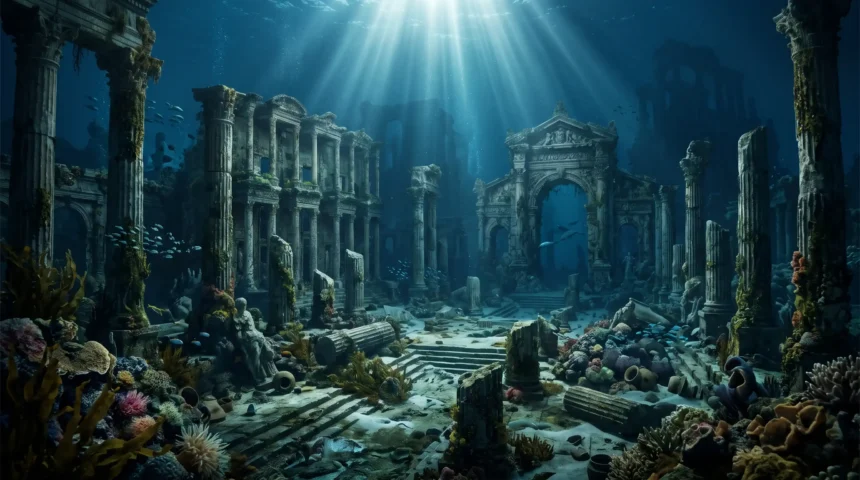
Imagine discovering a city hidden beneath the ocean, filled with ancient temples, enormous buildings, and mysterious structures that have remained untouched for thousands of years. It sounds like something from an adventure movie, but this is exactly the kind of mystery that has kept people fascinated by Atlantis for centuries.
Atlantis is one of the most famous lost civilizations in history. According to ancient stories, it was once a powerful island society with impressive architecture, enormous wealth, and a highly organized way of life. Then, supposedly, a series of terrible natural disasters caused the entire civilization to disappear beneath the sea.
But there is one big question: Did Atlantis actually exist, or was it simply a story created by an ancient philosopher?
Let’s explore the history, theories, and mysteries surrounding this legendary lost city.
What Was the Lost City of Atlantis?

The story of Atlantis comes from the writings of the ancient Greek philosopher Plato, who described the mysterious civilization around 360 BC.
He mentioned Atlantis in two famous philosophical works, Timaeus and Critias.
According to Plato, Atlantis was a powerful island located beyond the Pillars of Hercules, a name commonly associated with the Strait of Gibraltar. He described it as a wealthy civilization with impressive buildings, organized communities, busy harbors, and valuable natural resources.
Atlantis was supposedly much more powerful than many surrounding societies. However, its people eventually became greedy and ambitious, losing the qualities that had once made their civilization great.
Plato’s account ends with a dramatic event: earthquakes and floods destroyed the island, causing it to disappear beneath the ocean.
What makes this story especially interesting is that, despite centuries of searching, no archaeological discovery has confirmed the existence of Atlantis as Plato described it.
What Did Atlantis Look Like?
One reason the Atlantis story became so popular is Plato’s detailed description of its capital city.
Rather than describing an ordinary settlement, he presented a city with an unusual circular design. Rings of land and water supposedly surrounded a central island, creating a remarkable system of canals and waterways.
According to the ancient account, Atlantis included:
- Large temples dedicated to ancient gods.
- Impressive palaces and public buildings.
- Circular waterways connecting different areas.
- Harbors filled with ships and trading vessels.
- Strong walls and enormous monuments.
- Fertile agricultural land and valuable natural resources.
The city was described as a place where architecture, wealth, and natural surroundings came together.
These details have inspired countless artists, writers, and filmmakers to imagine what Atlantis might have looked like.
However, it is important to remember that these descriptions come from Plato’s writings. They are not confirmed archaeological findings.
How Did Atlantis Disappear?
The disappearance of Atlantis is perhaps the most fascinating part of the entire story.
Plato described Atlantis as a civilization that gradually became corrupted by its growing power and wealth. Its rulers and people supposedly became more interested in expansion and control than in maintaining their original values.
Eventually, the civilization faced a catastrophic disaster.
According to Plato, powerful earthquakes and floods struck the island. The destruction was so severe that Atlantis disappeared beneath the sea in a remarkably short period.
This dramatic ending is one reason why the story has remained popular for more than two thousand years.
Some researchers believe that Plato’s description may have been influenced by real natural disasters from the ancient world. However, there is no confirmed evidence connecting a particular earthquake or flood directly to Atlantis.
Where Could Atlantis Have Been Located?
For centuries, explorers, historians, and researchers have tried to identify the possible location of Atlantis.
Several places have attracted attention, but none has been scientifically confirmed as the legendary city.
1. The Atlantic Ocean
One of the most popular theories places Atlantis somewhere in the Atlantic Ocean.
This idea comes mainly from Plato’s description of an island beyond the Pillars of Hercules. Some people believe the remains of such a civilization could be hidden underwater.
Despite numerous searches and theories, no accepted archaeological evidence has identified Atlantis in the Atlantic Ocean.
2. Santorini, Greece
<Add Image: Santorini volcanic island and caldera aerial view>
Another interesting theory connects Atlantis with Santorini, a Greek island also known as ancient Thera.
During the second millennium BC, a massive volcanic eruption devastated parts of the island and affected nearby coastal communities. The eruption was one of the most significant volcanic events of the ancient Mediterranean world.
Some researchers have suggested that memories of this disaster might have influenced the Atlantis story.
The similarities between a destroyed island civilization and Plato’s description are certainly interesting. However, there is no historical proof that Santorini was Atlantis.
3. Southern Spain
Southern Spain is another region that has been suggested as a possible location.
Some researchers have investigated ancient settlements and coastal landscapes in the area, looking for similarities with Plato’s descriptions.
The region’s ancient history and changing coastlines have made it an interesting subject for investigation.
However, no discovery has established that Atlantis existed there.
Was Atlantis More Advanced Than Other Ancient Civilizations?
Modern stories often portray Atlantis as an incredibly advanced civilization, sometimes even suggesting that its people possessed technology far beyond anything known in the ancient world.
But what does the historical evidence actually tell us?
In Plato’s account, Atlantis was wealthy and well organized. It supposedly had impressive buildings, ships, harbors, and developed infrastructure.
Over time, these descriptions inspired stories about extraordinary inventions and mysterious technologies.
Some popular theories even claim that Atlantis had electricity or flying machines. However, there is no reliable archaeological evidence supporting these ideas.
In reality, ancient civilizations such as Egypt, Mesopotamia, and the Indus Valley already achieved remarkable things through their knowledge of architecture, mathematics, engineering, and urban planning.
We don’t need to imagine impossible technology to appreciate how advanced ancient societies could be.
Why Are People Still Searching for Atlantis?
More than two thousand years after Plato first described Atlantis, people are still fascinated by the possibility of discovering it.
Part of the attraction comes from the mystery itself. The idea that an entire civilization could disappear and leave behind unanswered questions is something that naturally captures people’s curiosity.
There are also genuine archaeological reasons to investigate ancient underwater sites.
Over thousands of years, rising sea levels, earthquakes, volcanic activity, and coastal changes have submerged settlements that once existed above water.
Modern researchers can investigate these locations using technologies such as:
- Underwater sonar: Helps researchers map the ocean floor.
- Submarine exploration: Allows scientists to investigate underwater environments.
- Archaeological surveys: Help identify and study possible historical remains.
- Underwater mapping: Creates detailed pictures of submerged landscapes.
These technologies have helped researchers discover real ancient settlements and archaeological remains beneath the water.
However, none of these discoveries has conclusively identified Atlantis.
Was Atlantis Real or Just a Myth?
This is the question that has kept the Atlantis mystery alive for centuries.
The main historical source for Atlantis is Plato’s writing. However, historians have different interpretations of what he intended the story to represent.
Some believe Plato may have used real historical events and natural disasters as inspiration. Others argue that Atlantis was mainly a fictional civilization created to communicate philosophical ideas about power, ambition, morality, and society.
There is also the possibility that the story combined elements of ancient traditions with Plato’s own imagination.
At present, there is no accepted archaeological evidence proving that Atlantis existed exactly as described.
That doesn’t make the story any less interesting. It simply means we should separate fascinating theories from established historical facts.
Conclusion
The Lost City of Atlantis remains one of the greatest mysteries of ancient history.
Its legendary temples, impressive architecture, wealthy society, and sudden disappearance have inspired generations of people to search for answers.
Although several locations have been suggested, no confirmed discovery has revealed the remains of Plato’s legendary civilization.
Perhaps Atlantis was inspired by a real ancient disaster. Perhaps it was entirely a philosophical story. For now, we simply don’t have enough evidence to know for certain.
And that is what makes Atlantis so fascinating: even after more than two thousand years, its story continues to leave us with one unforgettable question — was there really a lost city waiting beneath the ocean?