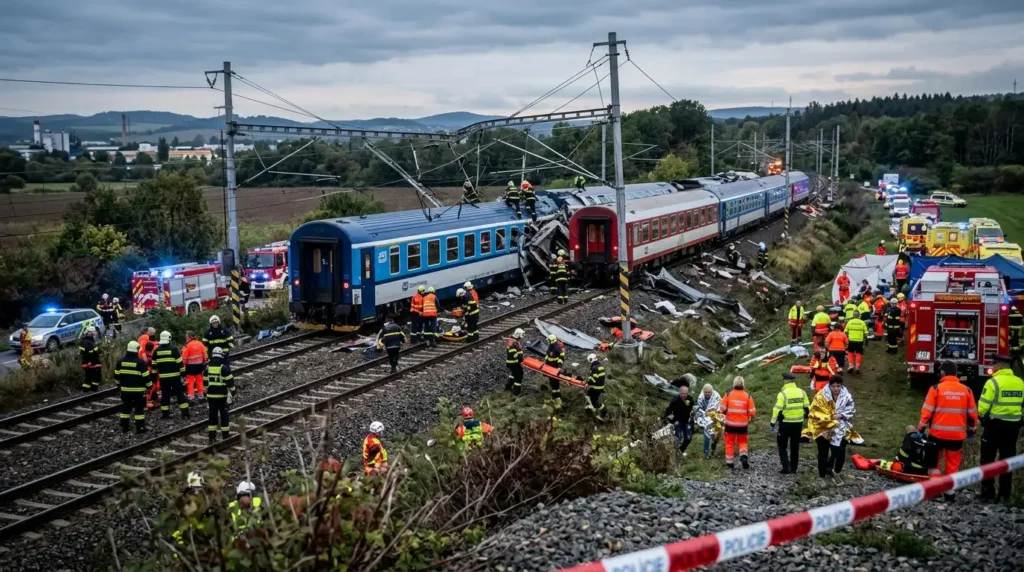
A major railway accident near Prague has raised fresh concerns about passenger safety in the Czech Republic after two trains were involved in a collision that reportedly left 46 people injured.
The incident has attracted attention because railway networks are an important part of everyday transportation across Europe. Thousands of passengers depend on trains to travel between cities, commute to work and reach their destinations safely.
The reported collision has also raised questions about what happened before the trains came into contact, whether railway safety systems worked as expected and what investigators will examine next.
As emergency responders dealt with the aftermath, railway authorities faced the difficult task of assessing the damage, helping affected passengers and investigating the circumstances surrounding the accident.
What Happened in the Train Collision Near Prague?
According to the initial report, two trains were involved in a collision near Prague, the capital of the Czech Republic.
The accident reportedly resulted in 46 injuries, prompting an emergency response from local authorities and medical services.
Emergency teams were called to the scene to assist passengers and assess the situation.
The collision disrupted railway operations in the affected area while authorities worked to establish what had happened.
At this stage, the exact circumstances surrounding the incident require confirmation from official Czech railway and emergency-service reports.
How Many People Were Injured?
Initial reports put the number of injured passengers at 46.
People affected by a train collision can experience different levels of injury, depending on the circumstances of the incident and the force involved.
Emergency responders normally assess passengers at the scene before arranging transportation to hospitals when necessary.
Authorities also work to identify everyone involved and ensure that passengers who need medical attention receive appropriate treatment.
The final injury figures may change as medical assessments and official investigations progress.
What Happened After the Accident?
Following a major railway collision, emergency services generally focus on several immediate priorities.
These include assisting injured passengers, checking train compartments, securing the accident area and preventing additional railway incidents.
Railway operators may temporarily suspend services on affected tracks while emergency teams and investigators work.
Passengers travelling through nearby stations can also experience delays, cancellations or alternative transport arrangements.
For families waiting for passengers, obtaining accurate information from official authorities is particularly important during the initial response.
What Could Have Caused the Train Collision?
The exact cause of the reported Prague-area collision should not be assumed before investigators publish their findings.
However, railway accident investigations generally examine several possible factors.
1. Signalling Problems
Railway signalling systems help control train movements and maintain safe distances between services.
Investigators may examine whether signals displayed the correct information and whether the systems recorded any unusual activity.
2. Human Error
Train operators and railway control personnel work under strict procedures.
Investigators may review communication records, operating decisions and other relevant information to determine whether human factors contributed to an incident.
3. Technical Problems
Mechanical or technical failures can affect railway operations.
Investigators may examine train braking systems, onboard equipment and track infrastructure.
4. Railway Infrastructure
The condition of tracks, switches and other railway equipment can also be relevant.
Specialists may inspect the accident location to establish whether infrastructure problems played any role.
These are standard areas of investigation, not confirmed causes of this particular collision.
How Do Authorities Investigate a Major Railway Accident?
Railway accident investigations are usually detailed processes.
Investigators may examine:
- Train event recorder information.
- Signalling and communication records.
- Track and railway infrastructure.
- Train maintenance history.
- Statements from railway employees and witnesses.
- Video recordings where available.
The objective is to establish the sequence of events and identify whether safety procedures or technical systems failed.
Authorities may also issue recommendations aimed at preventing similar incidents in the future.
Why Is Railway Safety Important Across Europe?
Railways connect major European cities and provide transportation for millions of passengers.
Countries across Europe have invested in modern trains, signalling systems and railway infrastructure.
However, even modern railway networks require continuous maintenance, monitoring and safety improvements.
Major accidents can affect public confidence in rail transportation and create questions about whether existing safety arrangements are sufficient.
For this reason, investigations into serious railway incidents are important beyond the location where an accident occurs.
Other railway operators may also review safety procedures when investigators identify lessons that could apply to their networks.
Will Train Services Near Prague Be Affected?
A serious collision can disrupt normal railway operations, particularly when an accident occurs on an important passenger route.
Authorities may need to close affected tracks while emergency operations and investigations continue.
Depending on the location and damage, passengers could experience:
- Delayed train services.
- Cancelled journeys.
- Changes to departure platforms.
- Replacement bus services.
- Longer travel times.
Passengers planning journeys near the affected area should check current updates from Czech railway operators before travelling.
What Happens Next?
The next important step is the official investigation into the collision.
Authorities will need to establish exactly how the trains came into contact and whether any technical, operational or infrastructure-related factors contributed.
Investigators will also assess the condition of the trains and railway tracks.
Further information may clarify the circumstances of the accident, the condition of injured passengers and the expected timeline for restoring normal railway operations.
Until an official investigation provides answers, claims about the cause should be treated carefully.
Frequently Asked Questions (FAQs)
Where did the train collision happen?
Initial reports described a collision involving two trains near Prague, the capital of the Czech Republic. The precise location should be confirmed through official railway reports.
How many people were injured in the Prague train collision?
Initial reports stated that 46 people were injured. The final number may change as authorities complete their assessments.
What caused the train collision near Prague?
The confirmed cause has not been established in the information available for this article. Investigators may examine signalling, technical systems, railway infrastructure and operational procedures.
Were emergency services involved?
Yes, the reported accident prompted an emergency response to assist affected passengers and assess the situation.
Are train services affected near Prague?
A collision can cause temporary railway delays and cancellations. Passengers should check official Czech railway travel updates for current service information.
How are train collisions investigated?
Investigators examine train data, signalling records, communication systems, track conditions, maintenance history and witness information to establish what happened.
Is it safe to travel by train in the Czech Republic?
A single railway accident does not establish that the entire railway network is unsafe. Passengers should follow official travel and safety announcements.
Final Thoughts
The reported train collision near Prague is a reminder of how important railway safety and emergency preparedness are.
With 46 people reportedly injured, the incident has created serious concerns for affected passengers and their families.
The immediate priority remains medical assistance and support for everyone involved. After that, investigators will need to establish the cause and determine whether improvements are necessary to prevent similar accidents.
For now, the most important thing is to rely on verified updates rather than unconfirmed explanations about what happened.
Article update: November 18, 2026. Initial incident details should be updated when official investigation findings become available.