Imagine swimming through an ancient ocean millions of years ago, when enormous marine reptiles moved beneath the waves. One of the most impressive creatures living in these waters was Mosasaurus, a giant marine predator that existed during the Late Cretaceous Period.
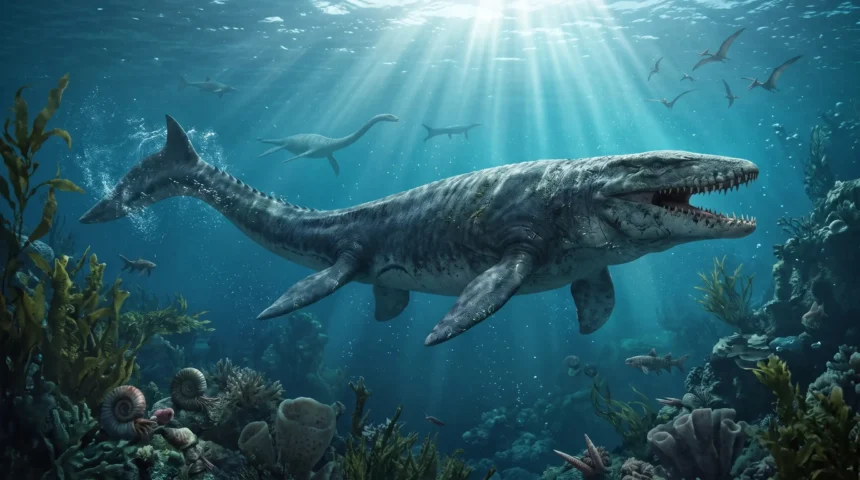
With its long body, powerful tail, paddle-like flippers, and jaws filled with sharp teeth, Mosasaurus was perfectly suited to life underwater. It was one of the most remarkable predators of its time and remains a fascinating subject for scientists studying prehistoric marine life.
Although it disappeared millions of years ago, its fossils continue to reveal interesting details about the ancient oceans and the creatures that once lived there.
What Was Mosasaurus?
Mosasaurus was a large marine reptile belonging to a group of animals known as mosasaurs. Although people sometimes mistake it for a dinosaur, Mosasaurus was not actually a dinosaur. It was more closely related to modern lizards and snakes.
Its name means “Meuse lizard,” which comes from the Meuse River near Maastricht in the Netherlands. Some of the earliest recognized Mosasaurus fossils were discovered in this region.
Unlike reptiles that lived on land, Mosasaurus was completely adapted to an aquatic lifestyle. Its legs had evolved into powerful flippers, and its long, muscular tail helped it move efficiently through the water.

How Big Was Mosasaurus?
One of the first things people wonder about Mosasaurus is just how enormous this animal could become.
The largest known species, Mosasaurus hoffmannii, is estimated to have reached around 17 to 18 meters in length. That is longer than many modern buses!
However, its exact size is still a subject of scientific discussion. Complete skeletons are uncommon, so researchers often use skull fossils and comparisons with related species to estimate its overall length.
Even without knowing its precise maximum size, there is little doubt that Mosasaurus was an enormous marine reptile. Its impressive body and strong swimming abilities made it a major predator in the ancient seas.
What Made Mosasaurus Such a Powerful Predator?
Mosasaurus was not simply a large animal. Its body had several adaptations that made it an effective ocean hunter.
Its long tail provided much of the power needed for swimming, while its four paddle-like flippers helped it control movement and direction. These features allowed it to move through the water while searching for food.
Its jaws were another important feature. They contained sharp, backward-curving teeth that helped it grip and hold onto struggling prey.
Scientists have also discovered that mosasaurs had flexible skull structures. These adaptations helped them handle and swallow relatively large food items.
Together, these features made Mosasaurus one of the most impressive marine predators of the Late Cretaceous.
What Did Mosasaurus Eat?
With its powerful jaws and sharp teeth, Mosasaurus was clearly built to eat other animals. It was a carnivore that hunted a variety of creatures living in prehistoric oceans.
Its possible prey included fish, sharks, squid-like animals, turtles, and other marine reptiles.
Interestingly, fossil discoveries have provided evidence that some mosasaurs even consumed other marine reptiles. Remains found in fossil stomach contents suggest that these animals sometimes hunted surprisingly large prey.
Not every mosasaur had exactly the same diet. Different species had different tooth shapes and skull structures, which may have helped them feed on different types of marine animals.

Alt Text: A Mosasaurus chasing ancient fish through the prehistoric ocean.
Where Did Mosasaurus Live?
Mosasaurus was not limited to a single part of the world. Fossils have been discovered in several regions, including Europe and North America.
During the Late Cretaceous Period, sea levels were considerably higher than they are today. Vast areas of land were covered by shallow seas, creating large underwater environments filled with marine life.
One famous example was the Western Interior Seaway in North America. This enormous inland sea covered parts of what is now central North America and provided a habitat for many different marine animals.
These ancient waters supported fish, sharks, turtles, marine reptiles, and other creatures. As a major predator, Mosasaurus lived in an environment where plenty of potential prey was available.
The discovery of its fossils across different regions shows just how widespread these fascinating marine reptiles once were.
Was Mosasaurus Bigger Than Megalodon?
Mosasaurus and Megalodon are two of the most famous prehistoric ocean predators, and people often wonder which one was bigger.
However, there is one important difference between them: they lived during completely different periods.
Mosasaurus existed during the Late Cretaceous Period and disappeared around 66 million years ago. Megalodon appeared much later, millions of years after Mosasaurus had become extinct.
They were also very different animals. Mosasaurus was a marine reptile, while Megalodon was an enormous prehistoric shark.
Both were impressive predators, but comparing them is not quite as simple as looking at their sizes. Their body structures, swimming styles, and hunting adaptations were very different.
Why Did Mosasaurus Become Extinct?

For millions of years, mosasaurs were important predators in ancient oceans. But their story came to an end around 66 million years ago.
This happened during the mass extinction event at the end of the Cretaceous Period, when a massive asteroid struck the region that is now part of Mexico.
The impact triggered major environmental changes across the planet. Climate conditions shifted, ecosystems were disrupted, and food chains began to collapse.
Marine environments were also affected, making survival difficult for many ocean species. Mosasaurs eventually disappeared along with numerous other groups of prehistoric animals.
Their extinction marked the end of an important chapter in the history of Earth’s oceans.
Why Is Mosasaurus Still Fascinating Today?
Even though Mosasaurus has been extinct for millions of years, people are still fascinated by this enormous marine reptile.
Part of its popularity comes from its unusual appearance and impressive size. It represents a time when giant reptiles occupied the top positions in many marine food chains.
Its fossils also provide valuable information about evolution, ancient ecosystems, and how reptiles gradually adapted to life in the ocean.
Mosasaurus has even appeared in popular movies, particularly the Jurassic World film series. These appearances have introduced the animal to a much wider audience, although its movie representation is often exaggerated for entertainment.
The real Mosasaurus was already an extraordinary creature without needing any Hollywood effects.
Final Thoughts
Mosasaurus was one of the most remarkable marine reptiles ever to live. With its enormous body, powerful tail, and specialized jaws, it was well adapted to hunting in the oceans of the Late Cretaceous Period.
Although it disappeared around 66 million years ago, its fossils continue to help scientists understand what ancient marine ecosystems looked like.
Today, Mosasaurus remains a fascinating reminder of how different life on Earth once was. The oceans that we know today are home to many incredible animals, but millions of years ago, they were ruled by creatures that were almost impossible to imagine.