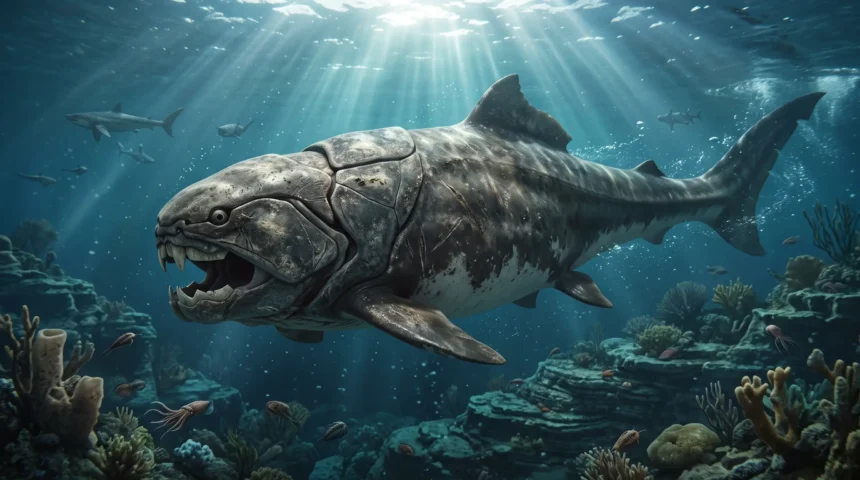
Imagine swimming through an ancient ocean and suddenly encountering a giant fish covered in thick armour, with powerful jaws unlike anything seen in modern marine life. Sounds terrifying, right? Millions of years ago, creatures like this actually existed.
One of the most fascinating predators of that time was Dunkleosteus, an enormous armoured fish that lived long before dinosaurs appeared on Earth. With its unusual skull, protective body armour, and powerful jaws, it was one of the most remarkable animals of the Devonian Period.
Dunkleosteus lived approximately 382 to 358 million years ago. Although it has been extinct for millions of years, its fossils still reveal incredible details about what life was like beneath prehistoric oceans.
What Was Dunkleosteus?
Dunkleosteus was an extinct genus of large armoured fish that lived during the Late Devonian Period.
It belonged to a prehistoric group known as placoderms. These fish were different from most species we see today because parts of their bodies were protected by thick bony plates.
However, the head of Dunkleosteus was especially impressive. It had a heavily armoured skull and sharp bony jaw plates instead of ordinary teeth.
This unusual structure helped it capture and process prey, making it a fascinating predator of ancient marine ecosystems.
How Big Was Dunkleosteus?
One of the first things people notice about Dunkleosteus is its enormous appearance.
The best-known species, Dunkleosteus terrelli, was a large marine predator. Its exact size remains a subject of scientific discussion because complete fossil skeletons are rare.
Older estimates suggested that it could reach around 10 meters in length, but more recent studies have proposed smaller sizes for many specimens.
Despite these uncertainties, there is no doubt that Dunkleosteus was an impressive animal.
Some of its most remarkable physical features included:
- A large, heavily armoured head.
- Thick protective bony plates.
- Powerful jaws with sharp cutting edges.
- A strong body adapted for swimming.
- Well-developed fins for movement through the water.
Its unusual appearance made it very different from the fish swimming in our oceans today.
Where Did Dunkleosteus Live?

Dunkleosteus lived in ancient marine environments during the Devonian Period, a time often called the Age of Fishes.
Fossils of this prehistoric fish have been discovered in several regions, including North America, Europe, and North Africa.
Back then, Earth’s oceans looked very different from the marine environments we know today. They were filled with unusual armored fish, early sharks, ancient invertebrates, and many other strange creatures.
These underwater ecosystems provided the perfect environment for large predators like Dunkleosteus to survive and hunt.
What Did Dunkleosteus Eat?
With its powerful jaws and sharp bony plates, Dunkleosteus was clearly adapted for a meat-based diet.
Scientists believe it was a carnivore that hunted other marine animals. Its possible prey included smaller fish, other armored fish, and various aquatic organisms.
Its jaw structure is particularly interesting because it worked differently from the teeth of modern predators.
Rather than relying on rows of conventional teeth, Dunkleosteus used sharp bony edges to grip and cut its prey.
This unusual feeding adaptation is one of the reasons scientists continue to study this prehistoric fish.
What Made Dunkleosteus So Special?
There were many unusual creatures living during the Devonian Period, but Dunkleosteus had several features that made it stand out.
Its most recognisable characteristic was its armoured head.
The thick bony plates protected important parts of its body, while its powerful jaw structure helped it capture prey.
Another interesting feature was the way its jaws worked. Researchers have studied its skull and jaw mechanics to understand how this ancient fish could deliver powerful bites.
Unlike modern sharks, which have replaceable teeth, Dunkleosteus relied on its own specialized bony jaw structures.
These adaptations make it an important species for understanding the evolution of early marine predators.
Why Did Dunkleosteus Become Extinct?
Despite being one of the most impressive predators of its time, Dunkleosteus eventually disappeared from Earth’s oceans.
Its extinction is associated with the Late Devonian extinction events, a period when marine ecosystems experienced major environmental changes.
Scientists have investigated several possible factors behind these events.
Changes in Ocean Environments
During the Late Devonian, ancient marine environments went through significant changes. These shifts affected the habitats of many underwater species.
Changes in Oxygen Levels
Oxygen availability in some ocean environments may have declined, making survival more difficult for marine organisms.
Major Ecological Changes
The marine food web was also changing. As different species declined or disappeared, the balance of ancient ocean ecosystems was affected.
The exact reasons behind the disappearance of Dunkleosteus are still being investigated through fossil discoveries and geological research.
Can Dunkleosteus Still Exist Today?
Unfortunately, Dunkleosteus is completely extinct.
There is no scientific evidence that living populations of this prehistoric fish exist anywhere in today’s oceans.
Everything scientists know about this remarkable creature comes from fossil remains, particularly its impressive skull and jaw structures.
These discoveries allow researchers to reconstruct parts of its appearance and learn more about how it lived millions of years ago.
Although we cannot see a living Dunkleosteus swimming through the ocean today, its fossils provide a fascinating window into Earth’s distant past.
What Can We Learn From Dunkleosteus?
Dunkleosteus is more than just an unusual prehistoric fish. It represents an important chapter in the evolution of marine life.
Its armored body and specialized jaws show how early fish developed different adaptations to survive in ancient underwater environments.
Studying creatures like Dunkleosteus also helps scientists understand how marine ecosystems changed over millions of years.
Perhaps the most interesting lesson is that today’s oceans are only a small part of Earth’s incredible natural history. Long before modern whales, sharks, and other familiar marine animals appeared, completely different predators ruled the seas.
Frequently Asked Questions
When Did Dunkleosteus Live?
Dunkleosteus lived during the Devonian Period, approximately 382 to 358 million years ago.
How Big Was Dunkleosteus?
It was a large armored fish. Its exact size is debated, and older estimates of up to 10 meters may be too high.
What Did Dunkleosteus Eat?
It was a carnivorous predator that likely fed on other prehistoric fish and marine animals.
Did Dunkleosteus Have Teeth?
Not like modern sharks. Instead, it had sharp bony jaw plates that formed cutting edges.
Why Did Dunkleosteus Become Extinct?
Its disappearance is associated with the Late Devonian extinction events, a period of significant environmental changes in marine ecosystems.
Was Dunkleosteus Bigger Than a Great White Shark?
Dunkleosteus was certainly an impressive prehistoric predator, but its exact size remains debated. Some modern great white sharks can also reach considerable lengths, so a direct comparison depends on which size estimates are used.
Conclusion
Dunkleosteus was one of the most fascinating predators to ever inhabit Earth’s ancient oceans. Its heavily armored head, unusual jaw structure, and impressive size made it unlike almost any fish alive today.
Although it disappeared around 358 million years ago, its fossil remains continue to help scientists understand the evolution of marine predators.
It’s amazing to think that millions of years before dinosaurs walked the Earth, creatures like Dunkleosteus were already ruling the underwater world. Its story reminds us just how strange, diverse, and extraordinary prehistoric life really was.