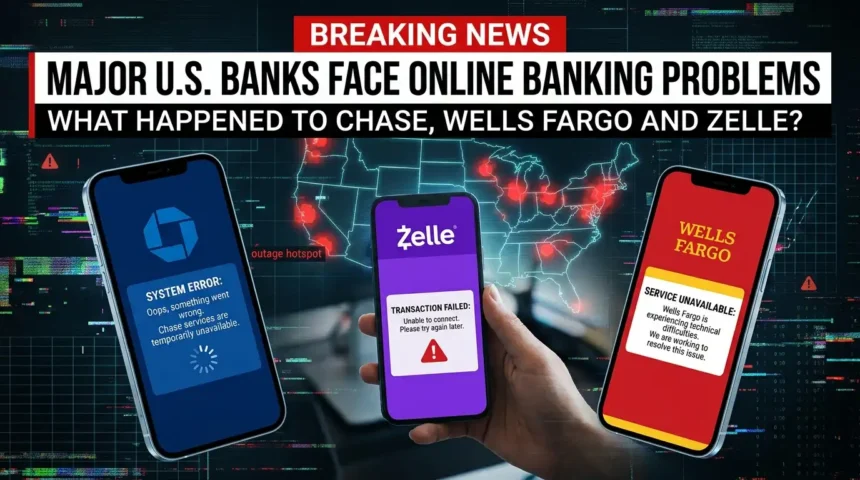
Thousands of customers across the United States reported problems accessing banking services on November 16, 2026. Customers using major financial institutions, including JPMorgan Chase, Bank of America, Wells Fargo and U.S. Bank, experienced difficulties with online transactions and digital payment services.
The reports quickly attracted attention as customers turned to outage-tracking websites to report problems with their banking apps and accounts.
However, the main technical issue was linked to JPMorgan Chase. The bank confirmed that a software bug affecting its internal hardware systems was causing some transactions to take longer than usual.
The situation also affected some payments involving Zelle, a popular money transfer service used by millions of Americans.
Although the disruption created concern among customers, Chase said the issue was not caused by a cyberattack and that customers still had access to their accounts and funds.
Here’s what happened, which banks were involved and why the incident matters for online banking.
What Happened to Major US Banks on November 16?
On Monday, November 16, customers began reporting difficulties accessing online banking services at several major US financial institutions.
According to reports tracked by Downdetector, complaints involved JPMorgan Chase, Bank of America, U.S. Bank, Wells Fargo and Truist. Some customers also reported problems with Zelle payments.
The reports increased throughout the morning and attracted attention across the United States.
However, the problems were not necessarily caused by separate outages at every bank.
JPMorgan Chase confirmed that it was dealing with a technical issue affecting its internal hardware systems. Other financial institutions explained that some transactions involving Chase customers could experience delays.
This distinction is important because a delayed payment between two banks does not necessarily mean both banks are experiencing an outage.
Why Was Chase Bank Experiencing Technical Problems?
JPMorgan Chase identified a software bug in its on-premise hardware systems as the cause of the disruption.
The technical issue affected transaction processing, meaning some customers experienced longer waiting times when completing banking activities.
A Chase spokesperson explained that customers continued to have access to their accounts and funds despite the delays.
The bank also said it was working to resolve the issue as quickly as possible, with the aim of restoring normal service by the end of Monday.
Importantly, Chase stated that the incident was not the result of a cyberattack.
The company described the problem as an isolated technical issue rather than a wider banking system failure.
Which Banks Were Affected by the Reports?
Several well-known American banks appeared in customer outage reports.
These included:
- JPMorgan Chase: Confirmed a technical issue affecting some transactions.
- Bank of America: Customers reported difficulties, although the bank was not experiencing its own confirmed system outage.
- Wells Fargo: Appeared in customer complaints about online banking services.
- U.S. Bank: Said its systems were not directly affected, but some Zelle transactions involving other financial institutions could be delayed.
- Truist: Customers also reported difficulties, although the bank said its banking services were operating normally.
The reports demonstrate how problems at one financial institution can sometimes affect customers using services connected to other banks.
Was Zelle Also Down?
Zelle customers also reported problems sending and receiving money during the banking disruption.
However, Zelle’s operator, Early Warning Services, said its payment network was fully operational.
The company explained that technical problems at participating financial institutions could cause delays in individual transactions.
This means that Zelle itself was not experiencing a confirmed network-wide outage.
Because Zelle payments depend on participating banks and credit unions, a problem at one institution can affect transfers involving customers at another institution.
That connection helps explain why some people experienced payment delays even when their own bank’s systems were working normally.
Was the Banking Disruption Caused by a Cyberattack?
No. JPMorgan Chase said the technical problem was not caused by a cyberattack.
The bank attributed the disruption to a software bug affecting its internal hardware systems.
There was also no confirmed connection between the banking issue and the recent Microsoft service disruption or the temporary problems affecting US air traffic control.
Although these incidents happened within a few days of one another, they were reported as separate technical problems.
This is an important distinction because not every major technology outage is the result of hacking or malicious activity.
Why Are Online Banking Problems a Serious Concern?
Digital banking has become an essential part of everyday life.
People use banking applications to pay bills, transfer money, receive salaries, check account balances and manage business transactions.
When these services become unavailable or slow down, even temporarily, customers can experience considerable inconvenience.
For businesses, delayed payments can also affect daily operations and financial planning.
The recent incident highlights how connected modern financial institutions have become. A technical problem at one bank can create delays for customers using payment services involving other institutions.
It also shows why banks must continuously maintain their technology systems and prepare for unexpected technical problems.
What Happens Next?
Following the disruption, JPMorgan Chase said it was working to restore normal transaction processing.
The bank expected the issue to be resolved by the end of November 16. However, the initial reports did not establish a complete independent confirmation of the restoration of every affected service.
Customers and financial institutions will continue to monitor digital banking services for further problems.
For now, the incident serves as another reminder that even large financial institutions can experience unexpected technology disruptions.
Frequently Asked Questions (FAQs)
Why were major US banks experiencing problems on November 16, 2026?
Customers reported online banking and payment difficulties after a software bug affected JPMorgan Chase’s internal hardware systems, causing delays in some transactions.
Was Chase Bank down on November 16?
Chase experienced technical problems that delayed some transactions. The bank said customers still had access to their accounts and funds.
Which US banks were mentioned in outage reports?
Customer reports mentioned JPMorgan Chase, Bank of America, U.S. Bank, Wells Fargo and Truist, among other financial institutions.
Was Zelle affected by the banking disruption?
Some customers experienced Zelle payment delays, but Early Warning Services said the Zelle network itself was fully operational.
Was the Chase banking issue caused by hackers?
No. Chase said the issue was caused by a software bug in its internal hardware systems and was not a cyberattack.
Were Bank of America and Wells Fargo directly affected?
Customers reported difficulties involving these banks, but the reports did not establish that both institutions had their own system outages. Some delays were connected to transactions involving Chase.
When did the US banking disruption happen?
The major wave of customer reports occurred on Monday, November 16, 2026.
Final Thoughts
The banking disruption of November 16 highlighted how much people depend on reliable digital financial services.
Although the main technical problem was linked to JPMorgan Chase, transaction delays created inconvenience for customers using other banks and payment services.
The incident was not confirmed to be a cyberattack, but it demonstrated how a software problem at one major financial institution can affect a much wider network.
As digital banking continues to grow, maintaining reliable technology will remain essential for banks and their customers.