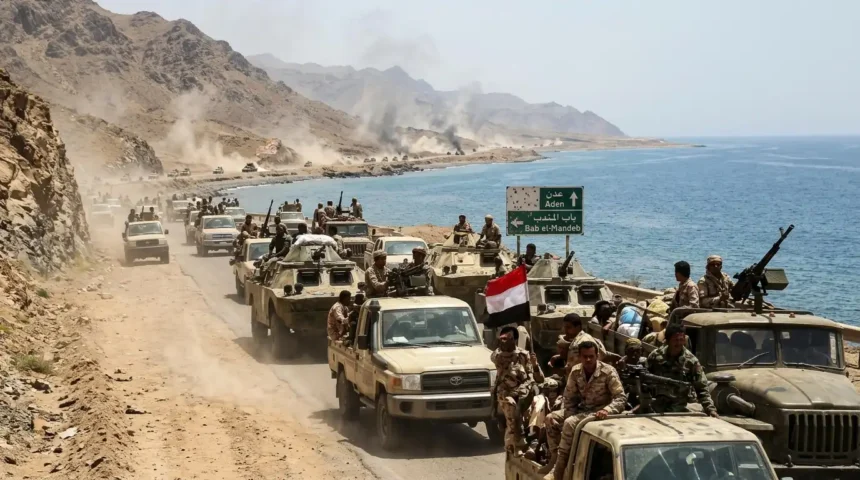
Yemen is facing another major development in its long-running conflict after government-aligned forces withdrew from areas near the strategic Bab el-Mandeb Strait. The decision has raised concerns about the security of one of the world’s most important shipping routes and the future of the country’s internationally recognised government.
On November 15, 2026, Yemen’s Southern Armed Forces announced that they were withdrawing from positions around Dhubab Airport and the Bab el-Mandeb area in western Yemen. Officials said the move was intended to strengthen the defence of Aden, the city that serves as the main base of the internationally recognised government.
The withdrawal comes as Houthi forces continue making advances in parts of southwestern Yemen. Their growing presence near important coastal areas has increased pressure on government forces and raised questions about the stability of the wider region.
The development is also attracting international attention because the Bab el-Mandeb Strait connects the Red Sea with the Gulf of Aden, making it an essential route for global shipping and energy transportation.
Why Did Yemeni Forces Withdraw From the Bab el-Mandeb Area?
According to the Southern Armed Forces, the withdrawal was part of a redeployment operation designed to strengthen security around Aden and neighbouring governorates.
In its statement, the group said protecting the country’s temporary capital and reinforcing other defensive positions had become a priority.
The announcement followed weeks of fighting between government-aligned forces and the Houthis.
Reuters reported that the withdrawal marked a major setback for a six-week government counteroffensive aimed at reclaiming territory along Yemen’s western coast.
Government forces had previously regained several positions around the strait but were unable to remove Houthi forces completely from the surrounding areas.
The military situation eventually placed additional pressure on government positions, particularly around Taiz and the approaches to Aden.

How Are Houthi Forces Changing the Situation in Yemen?
The Houthis have made significant territorial gains in southwestern Yemen during the latest phase of fighting.
Their advances have put additional pressure on government-aligned forces and increased concerns about the security of important roads and coastal areas.
According to reporting by Al Jazeera on November 16, the withdrawal from Dhubab and nearby positions followed growing pressure from Houthi fighters.
The movement has also increased pressure around Taiz, where government forces have faced serious difficulties.
For the internationally recognised government, maintaining secure connections between Aden, Taiz and coastal areas has become increasingly challenging.
The latest developments show how quickly the balance of control can change in a conflict involving several competing political and military groups.
Why Is Aden So Important?
Aden is one of Yemen’s most important cities.
After Houthi forces captured the capital, Sanaa, in 2014, the internationally recognised government moved its main operations to the southern city.
Since then, Aden has served as its principal political and administrative base.
The city is also an important port and commercial centre, making its security essential for government operations and everyday life.
Recent Houthi advances have increased concerns about the safety of the surrounding areas.
According to ABC News, sources cited by AFP said Houthi fighters had established positions relatively close to Aden, adding to concerns about a possible further advance.
For the government, defending Aden is therefore more than a military priority. It is also important for maintaining its political presence and administrative operations.
Why Is the Bab el-Mandeb Strait Important to Global Trade?
The Bab el-Mandeb Strait is one of the world’s most important maritime passages.
Located between Yemen and the Horn of Africa, it connects the Red Sea with the Gulf of Aden and the wider Indian Ocean.
<image placeholder: Insert a realistic geographical map showing Yemen, Djibouti, Eritrea and the Bab el-Mandeb Strait>
Thousands of commercial shipping operations depend on secure maritime routes through this wider region.
The strait is particularly important for vessels travelling between Europe and Asia through the Suez Canal.
Any serious disruption could force shipping companies to reconsider their routes, potentially increasing transportation costs and delivery times.
This is why developments in Yemen receive attention far beyond the Middle East.
Even countries that are not directly involved in the conflict can experience economic consequences if international shipping becomes less reliable.
Could the Yemen Conflict Affect International Shipping?
Yes. Continued instability near the Bab el-Mandeb Strait could create additional uncertainty for international shipping companies.
Commercial vessels operating near conflict-affected waters may face higher insurance costs, delays and additional security concerns.
The situation is particularly sensitive because the wider region has already experienced attacks and threats involving commercial shipping.
However, the withdrawal of government forces does not automatically mean that the entire strait has been closed.
The actual impact depends on future developments, the level of maritime security and whether commercial vessels can continue operating safely.
Shipping companies and international authorities will be watching the situation closely.
What Is Happening to Civilians in Yemen?
Beyond the political and strategic consequences, the conflict is creating serious challenges for ordinary Yemenis.
Years of fighting have damaged infrastructure, weakened public services and made daily life difficult for millions of people.
The latest escalation has added further pressure on communities around Taiz and other affected areas.
According to Reuters, Taiz has faced particularly difficult conditions, with humanitarian assistance restricted and large numbers of displaced people living under challenging circumstances.
ABC News also reported that the World Food Programme had warned that more than 18 million people in Yemen were facing acute food insecurity.
For families already dealing with economic hardship, further instability could make access to food, healthcare and basic services even more difficult.
The humanitarian situation remains one of the most serious consequences of Yemen’s prolonged conflict.
What Happens Next in Yemen?
The next stage of the conflict will largely depend on whether government-aligned forces can strengthen their positions around Aden and whether the Houthis continue expanding their influence in the surrounding regions.
Government officials have described the withdrawal as a redeployment intended to protect important areas.
However, the territorial changes represent a significant challenge for the internationally recognised government.
International observers will also be watching developments around the Bab el-Mandeb Strait because of its importance to global trade.
Diplomatic efforts and humanitarian support will remain essential as the situation develops.
For now, Yemen faces uncertainty on several fronts, and the coming days could bring further changes to the country’s political and security situation.
Frequently Asked Questions (FAQs)
Why did Yemeni government forces withdraw from Bab el-Mandeb?
Yemen’s Southern Armed Forces said they withdrew from positions near Bab el-Mandeb and Dhubab Airport to strengthen security around Aden and neighbouring areas.
When did Yemeni forces withdraw from the area?
The withdrawal was announced on November 15, 2026.
Who controls the Bab el-Mandeb area?
The situation is contested and has changed during recent fighting. Houthi forces have expanded their presence, while government-aligned forces have withdrawn from several positions in the area.
Why is Aden important in Yemen?
Aden is the main base of the internationally recognised Yemeni government and an important political, commercial and port city.
What is the Bab el-Mandeb Strait?
The Bab el-Mandeb Strait is a narrow maritime passage connecting the Red Sea with the Gulf of Aden. It is an important route for international shipping between Europe and Asia.
Could the Yemen conflict affect global trade?
Yes. Continued instability near the Bab el-Mandeb Strait could affect shipping routes, increase transportation costs and cause delays in international trade.
How many people in Yemen face food insecurity?
The World Food Programme warned in October 2026 that more than 18 million people in Yemen were facing acute food insecurity, according to ABC News.
Final Thoughts
The withdrawal of Yemeni government-aligned forces from areas near the Bab el-Mandeb Strait marks another important development in the country’s continuing conflict.
Although officials have described the move as a redeployment to protect Aden, the latest territorial changes have increased the pressure on the internationally recognised government.
The consequences could extend beyond Yemen, particularly because the Bab el-Mandeb Strait plays such an important role in international shipping.
For millions of Yemenis, however, the most immediate concern remains the humanitarian situation and the hope for greater stability after years of conflict.