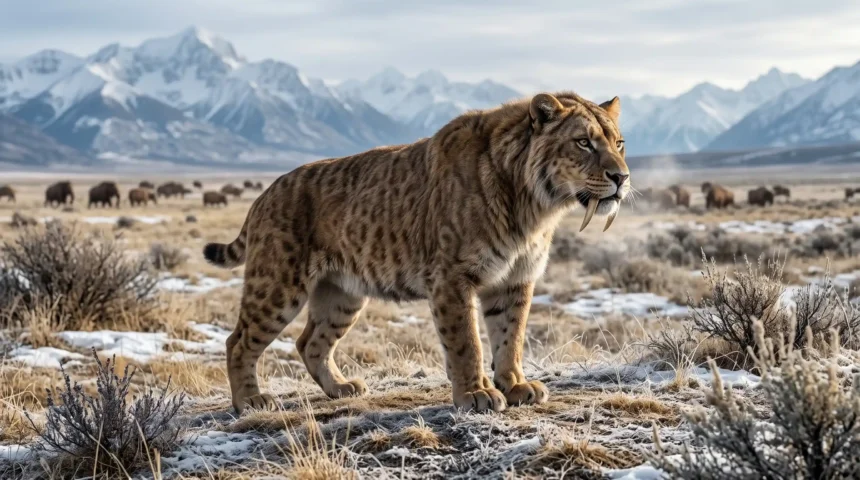
Imagine exploring an ancient landscape thousands of years ago when a powerful predator suddenly appears, showing two enormous teeth from its upper jaw. This unusual creature was known as Smilodon, one of the most recognizable predators of the Ice Age.
Often called the saber-toothed cat, Smilodon had a muscular body, strong front legs, and remarkably long canine teeth. Its appearance was quite different from the lions and tigers we know today.
Although this fascinating predator disappeared thousands of years ago, its fossils still help scientists understand what life was like during the Ice Age.
What Was Smilodon?
Smilodon was an extinct genus of saber-toothed cats that lived in North and South America during prehistoric times.
Many people call it a saber-toothed tiger, but it was not actually a tiger. Instead, it belonged to an ancient group of cats that developed unusually long upper canine teeth.
Scientists have identified three main species of Smilodon:
- Smilodon gracilis
- Smilodon fatalis
- Smilodon populator
Among these, Smilodon fatalis is probably the most famous. Thousands of its fossils have been recovered from the La Brea Tar Pits in California, making it one of the best-known prehistoric predators.
How Big Was Smilodon?
Smilodon was built differently from most modern big cats. Rather than having a slim and athletic body, it had a thick, muscular frame with particularly powerful front limbs.
Its size depended on the species. Smilodon populator was the largest and could weigh several hundred kilograms, while Smilodon fatalis was somewhat smaller but still remarkably strong.
Of course, its most impressive feature was its enormous upper canine teeth. In some individuals, these teeth reached around 18 to 20 centimeters in length.
These long, curved teeth gave Smilodon its unforgettable appearance and made it one of the strangest-looking predators of the Ice Age.

Why Did Smilodon Have Such Long Teeth?
The first thing most people notice about Smilodon is its incredibly long canine teeth. They were much longer than the teeth found in modern lions and tigers.
But why did this ancient predator need such unusual teeth?
Scientists believe they played an important role in capturing and killing prey. Smilodon also had a strong neck, muscular shoulders, and powerful front legs, which may have helped it control large animals during a hunt.
Another interesting feature was its ability to open its jaws extremely wide. This allowed its unusually long canine teeth to move into position.
Even today, researchers continue to study how Smilodon used these teeth and how its hunting techniques worked.
What Did Smilodon Eat?
Like modern big cats, Smilodon was a carnivore. Meat was the main part of its diet, and it lived in an environment filled with large Ice Age animals.
Scientists believe its potential prey included:
- Ancient bison
- Prehistoric horses
- Camels
- Giant ground sloths
- Other large mammals
Its powerful build suggests that it was well adapted to dealing with relatively large prey.
However, exactly how Smilodon hunted and captured these animals remains an interesting subject of scientific research.

Where Did Smilodon Live?
Smilodon once roamed across large parts of North and South America.
Fossils have been discovered in several locations, including California, Florida, and different regions of South America. This suggests that the animal was able to survive in a range of environments.
Its habitats included open grasslands, woodlands, and other landscapes where large herbivores could be found.
One particularly famous discovery site is the La Brea Tar Pits in Los Angeles, California. Thousands of fossils from Ice Age animals have been recovered there, including an impressive number of Smilodon remains.
These discoveries have given scientists a valuable opportunity to study the animal’s body structure, lifestyle, and prehistoric environment.
Was Smilodon Stronger Than a Modern Lion?
Comparing Smilodon with a modern lion is interesting because both animals were powerful predators, but their bodies were designed differently.
Smilodon had a shorter, stockier frame, powerful front limbs, and an especially muscular upper body. Modern lions have a different body structure that supports their own hunting abilities.
Their skulls were also quite different. Smilodon’s enormous canine teeth made its jaw structure particularly unusual.
Although Smilodon may have been exceptionally powerful in certain ways, it is difficult to say whether it was stronger than a modern lion. They lived in different environments and had different physical adaptations.
Why Did Smilodon Become Extinct?

Smilodon disappeared around 10,000 years ago, near the end of the Pleistocene Ice Age.
Its extinction was part of a much larger disappearance of large mammals across the Americas.
Scientists believe several factors may have contributed to its decline. As the climate became warmer, many landscapes changed, affecting the habitats of animals that had lived there for thousands of years.
The decline of large herbivores may also have reduced the food available to predators like Smilodon.
Human hunting pressure is another possible factor researchers consider, although the exact contribution of each cause is still debated.
Eventually, Smilodon vanished, leaving behind fossils that tell us about its extraordinary existence.
Amazing Facts About Smilodon
Here are some interesting facts that make this prehistoric predator so fascinating:
- Smilodon was not a true tiger.
- It belonged to an extinct group of saber-toothed cats.
- Its upper canine teeth could reach approximately 20 centimeters.
- It had a powerful, muscular body and strong front limbs.
- It lived in North and South America.
- Thousands of its fossils have been discovered at the La Brea Tar Pits.
- It became extinct around the end of the last Ice Age.
Final Thoughts
Smilodon was much more than just an ancient cat with enormous teeth. Its powerful build, unusual skull, and specialized hunting adaptations made it one of the most fascinating predators of the Ice Age.
Although it has been extinct for thousands of years, its fossils continue to reveal new details about prehistoric life and the animals that once ruled the Americas.
Today, Smilodon remains a perfect example of how different and extraordinary the ancient animal world really was.