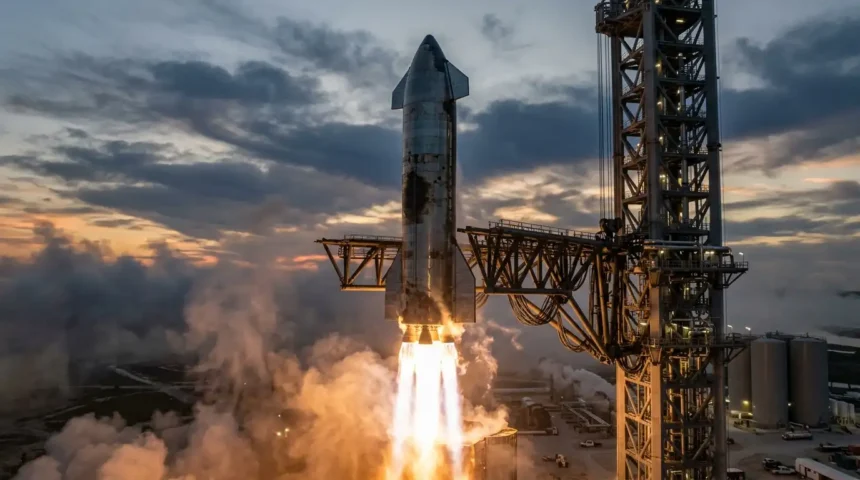
Imagine a rocket traveling thousands of miles per hour through space, completing a journey around Earth, and then returning to its launch site without simply falling into the ocean. Now imagine two giant mechanical arms reaching out to catch it in midair.
That incredible moment became reality on November 14, 2026, when SpaceX successfully caught the upper section of its Starship rocket as it returned from space. The achievement marked a major milestone in the company’s efforts to develop fully reusable rockets.
The historic landing took place at SpaceX’s Starbase facility in South Texas during Starship’s 15th test flight. Although the mission did not recover both parts of the rocket as originally planned, successfully catching the spacecraft itself was a remarkable step forward for space exploration.
What Happened During SpaceX’s Historic Starship Landing?
SpaceX launched its Starship rocket on November 13, 2026, from its Starbase facility in Texas. The mission was designed to test several important technologies, including the rocket’s ability to travel into orbit and return safely to Earth.
After separating from its Super Heavy booster, the Starship upper stage continued its journey into space. It spent approximately 22 hours above Earth and completed around 14 orbits before beginning its return journey.
During the mission, Starship also deployed 26 Starlink satellites into orbit.
The most exciting moment arrived on November 14, when the spacecraft returned to Texas. After passing through Earth’s atmosphere, it approached the launch tower and positioned itself for a controlled landing.
Instead of landing on a traditional platform, Starship was caught by two enormous mechanical arms attached to its launch tower.
For SpaceX, this was the first successful catch of the Starship spacecraft’s upper stage.
How Do SpaceX’s Giant Mechanical Arms Catch a Rocket?
One of the most interesting parts of this achievement is the technology behind the landing system.
SpaceX uses a special launch tower equipped with two enormous mechanical arms. These arms are commonly called “chopsticks” because of their appearance and the way they move toward the descending rocket.
The system is designed to catch a returning rocket stage instead of allowing it to land on its own legs.
During the final moments of the landing, Starship uses its engines to slow down and position itself vertically near the tower. Once it reaches the correct position, the mechanical arms move into place and secure the spacecraft.
SpaceX has already demonstrated this recovery technique with its Super Heavy booster on previous flights. However, catching the Starship upper stage after an orbital journey was a completely different challenge.
The November 14 achievement showed that the company had made important progress toward recovering both major sections of its massive rocket.
Why Is Reusing Rockets Such a Big Deal?
Traditional rockets often lose important components during launch or require expensive recovery and refurbishment operations.
This makes every space mission a major investment.
SpaceX wants to change that approach by developing rockets that can be recovered, inspected, refurbished when necessary, and launched again.
Reusable rockets could offer several important benefits:
1. Lower Spaceflight Costs
Building a new rocket for every mission can be extremely expensive. Recovering major rocket components could reduce the cost of future launches.
2. More Frequent Space Missions
If rockets can be reused reliably, companies may eventually be able to conduct launches more frequently without manufacturing an entirely new vehicle each time.
3. Less Manufacturing Waste
Recovering major rocket components could reduce the need to manufacture replacement hardware for every launch.
4. Better Opportunities for Deep Space Exploration
Reusable transportation systems could make ambitious missions to the Moon and potentially Mars more practical in the future.
However, these benefits depend on SpaceX proving that Starship can operate safely and reliably over repeated flights.
Why Didn’t SpaceX Catch Both Parts of the Rocket?
Although the mission achieved a historic milestone, it did not go exactly as planned.
SpaceX originally wanted to catch both the Super Heavy booster and the Starship upper stage at its Texas launch facility.
However, the Super Heavy booster experienced a problem during its return journey. A low-fuel condition led to an early end to its return burn, and its guidance system automatically diverted it toward an offshore landing in the Gulf of Mexico.
As a result, the booster was not caught by the launch tower.
The upper stage, meanwhile, continued its journey and successfully completed the planned return and catch.
This means Flight 15 was not a complete recovery of the entire rocket. Nevertheless, successfully catching the spacecraft after its journey through orbit was a major achievement.
What Does This Mean for NASA’s Moon Missions?
SpaceX’s Starship program is important for more than commercial space launches.
NASA has selected a modified version of Starship as part of its Artemis program, which aims to return astronauts to the Moon.
The spacecraft is expected to play a role in transporting astronauts from lunar orbit to the Moon’s surface.
Developing a reusable spacecraft could help support future lunar exploration and potentially longer missions.
However, Starship still needs additional testing and development before it can perform all the tasks required for crewed lunar missions.
The successful catch demonstrates progress, but it does not mean the spacecraft is already ready to transport astronauts.
Could SpaceX Eventually Use Starship for Mars Missions?
One of Elon Musk’s long-term ambitions is to make human travel to Mars possible.
Starship is being developed with that larger goal in mind.
Its enormous size and potential reusability could make it useful for transporting people, equipment, supplies, and other cargo on future deep-space missions.
However, reaching Mars is much more complicated than successfully landing a spacecraft back on Earth.
Future missions would need to address challenges such as long-distance travel, life-support systems, radiation protection, and reliable transportation.
The latest Starship achievement is an important step in rocket recovery technology, but a successful Mars mission will require many more breakthroughs.
What Happens Next for SpaceX Starship?
Following the successful upper-stage catch, SpaceX still has important work ahead.
Engineers will need to study the flight data, examine the recovered spacecraft, and investigate why the Super Heavy booster could not complete its planned tower recovery.
The company also needs to demonstrate that Starship can repeat this performance consistently.
One successful catch is exciting, but reliable reuse across multiple missions is the bigger goal.
Future Starship tests will help determine how quickly SpaceX can turn this experimental technology into a dependable space transportation system.
Final Thoughts
SpaceX’s November 14 achievement represents an exciting moment in modern space exploration.
Catching a spacecraft after it has spent more than 22 hours traveling around Earth sounds like something from a science-fiction movie. Yet SpaceX demonstrated that this ambitious recovery method is possible.
The Super Heavy booster did not return to the tower as planned, but the successful recovery of the Starship upper stage showed how far rocket technology has progressed.
If SpaceX can make this system reliable and repeatable, it could change how rockets are built, recovered, and launched in the future.
The next big question is no longer simply whether Starship can return from space. It is whether SpaceX can make this remarkable achievement part of everyday spaceflight.
Frequently Asked Questions (FAQs)
1. Did SpaceX successfully catch its Starship rocket?
Yes. On November 14, 2026, SpaceX successfully caught the Starship upper stage using the mechanical arms of its launch tower in South Texas.
2. When did SpaceX catch Starship?
The historic catch took place on November 14, 2026, during Starship’s 15th test flight.
3. How long did Starship spend in space?
Starship spent approximately 22 hours in space and completed around 14 orbits of Earth before returning.
4. What are SpaceX’s rocket-catching arms called?
They are commonly known as chopsticks because of their shape and movement. They are attached to the launch tower at Starbase.
5. Did SpaceX catch the Super Heavy booster too?
No. The Super Heavy booster diverted to an offshore landing in the Gulf of Mexico after experiencing a problem during its return journey.
6. Why does SpaceX want to reuse Starship?
SpaceX aims to reduce launch costs, increase launch frequency, and make space transportation more practical by recovering and reusing major rocket components.
7. Will Starship take astronauts to the Moon?
A modified Starship is part of NASA’s Artemis lunar exploration plans. However, additional testing and development are required before it can carry out crewed lunar missions.
8. Is SpaceX planning to use Starship for Mars?
Yes. Mars transportation is one of the long-term goals of the Starship program, although many technical challenges remain before such missions become possible.
Article takeaway: SpaceX successfully caught its Starship upper stage after an approximately 22-hour journey in space, marking a major milestone for reusable rocket technology. The Super Heavy booster recovery attempt was unsuccessful.