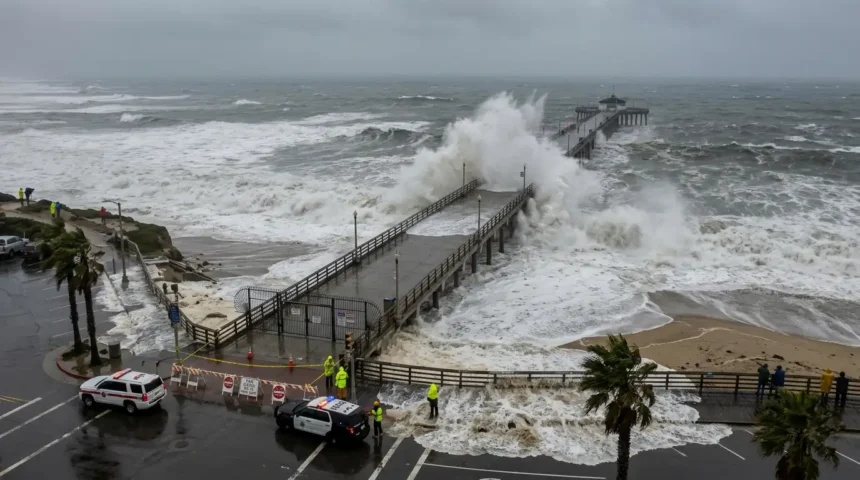
California’s coastline is known for its beautiful beaches, surfing spots, and peaceful ocean views. But over the weekend, the Pacific Ocean showed a very different side as powerful waves crashed against the shore, flooded coastal areas, and forced several popular piers to close.
The unusually large waves created dangerous conditions across parts of California, particularly around the Bay Area and other exposed coastal communities. Roads and public areas near the ocean were affected, while local authorities warned residents and visitors to stay away from dangerous surf.
Reports published on November 16, 2026, described waves reaching approximately 35 feet in parts of the Bay Area, with some exposed locations experiencing even larger swells.
The event quickly attracted attention because of its impact on familiar coastal destinations. For many people, it was a reminder that even a beautiful day near the ocean can become dangerous when powerful surf arrives.
What Happened Along the California Coast?
The powerful surf affected several communities along California’s coastline. Large waves repeatedly struck beaches, seawalls, and structures near the water, creating difficult conditions for residents and visitors.
Several popular piers were temporarily closed as a precaution. Reported closures included locations in Ventura, Manhattan Beach, Huntington Beach, Pacific Beach in San Diego, and Hermosa Beach.
These piers are popular destinations for tourists, fishermen, families, and people who simply enjoy walking beside the ocean. Their temporary closures showed how seriously local authorities were treating the situation.
Some coastal communities also experienced flooding concerns. In certain locations, seawater moved beyond the usual shoreline and reached nearby streets and public spaces.
The situation was especially concerning in areas where buildings, roads, and other infrastructure sit close to the ocean.
How Big Were the Waves in California?
One of the most remarkable details of this weather event was the reported height of the waves.
Parts of the Bay Area faced forecasts of waves reaching approximately 25 to 35 feet. At exposed surf locations near Mavericks in San Mateo County, some waves were reported to reach around 50 to 60 feet.
A buoy near Point Reyes also recorded a significant wave height of 31.2 feet on November 14, according to reports covering the event.
It is worth understanding that significant wave height represents an average of the highest waves measured over a period. It does not mean every wave reaches that height. Individual waves can be considerably larger or smaller.
Still, these measurements help explain why the conditions became a serious concern for coastal communities.
Why Were Waves So Powerful Along California’s Coast?
The main reason behind the unusually large surf was strong storm activity across the Pacific Ocean.
Powerful storms can generate enormous amounts of energy, creating swells that travel hundreds or even thousands of miles across the ocean. When these swells reach California, they can produce large breaking waves, particularly along exposed beaches and rocky coastal areas.
The direction of the swell, ocean depth, underwater geography, and local weather conditions all influence how large waves become near the shoreline.
This is why some coastal locations experience much stronger surf than nearby beaches.
Although broader ocean and climate patterns can influence seasonal conditions, the immediate cause of this particular event was linked to powerful Pacific swells.
Coastal Flooding Raises Concerns for California Residents
The large waves did more than create dramatic ocean views. They also raised concerns about flooding in communities located close to the shoreline.
In Pacifica, seawater pushed beyond coastal barriers and reached nearby streets. Other areas also experienced difficult conditions as waves moved onto beaches and coastal public spaces.
Near Capitola, local authorities issued an evacuation warning for some areas because of the dangerous surf conditions.
Reports also described seawater reaching parts of Seal Beach and areas near La Jolla Cove.
For people living in these communities, the situation highlighted the challenges of living close to the Pacific Ocean. Coastal roads, walkways, businesses, and public facilities can all become vulnerable when unusually