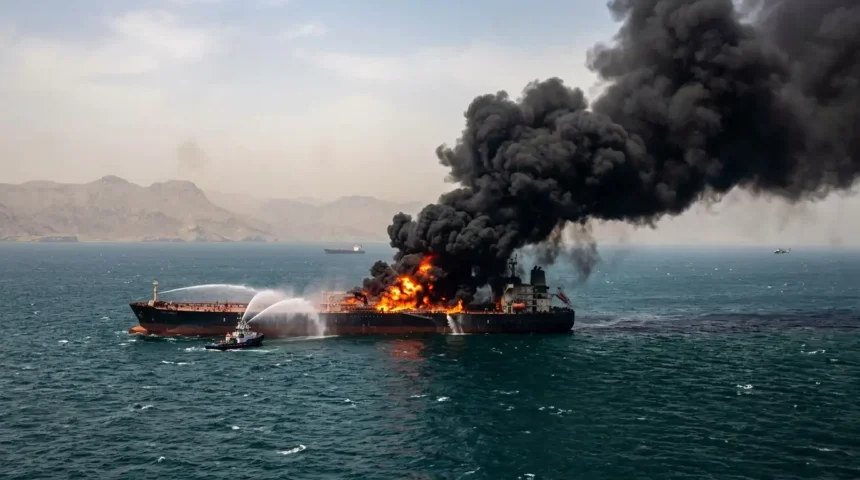
Another oil tanker has reportedly caught fire near the Strait of Hormuz, raising fresh concerns about the safety of international shipping in one of the world’s most important maritime routes.
On November 17, 2026, Iran’s Navy announced that a fourth oil tanker had caught fire after reportedly striking a naval mine east of the Strait of Hormuz. Iranian officials claimed that the vessel was travelling through a restricted maritime area without following the country’s announced navigation rules.
The latest incident comes at a time when tensions in the Middle East are already affecting commercial shipping. Several vessels have reportedly experienced explosions, fires or attacks in the surrounding waters over recent days.
However, there is an important detail to understand: the latest mine-strike account comes from Iranian authorities and has not been independently verified. International maritime agencies have separately reported incidents involving unknown projectiles in the same region.
So, what happened to the tanker, why is the Strait of Hormuz so important, and could these incidents affect global oil supplies? Here’s what we know.
What Happened to the Fourth Oil Tanker?
According to Iran’s Navy, an oil tanker caught fire after striking a naval mine in waters east of the Strait of Hormuz on November 17.
Iranian officials alleged that the vessel was travelling through a restricted maritime zone with its navigation systems switched off. They also claimed that the tanker had failed to follow the navigation rules announced by Iranian authorities.
The incident reportedly caused severe damage to the vessel.
However, Iranian officials did not publicly identify the tanker. Its name, registration, flag, cargo details and the condition of its crew were not included in the announcement.
This missing information makes it difficult to independently establish the full circumstances of the incident.
The report has nevertheless attracted international attention because it represents another reported tanker incident in an already tense shipping environment.
Why Are Multiple Oil Tankers Catching Fire Near Hormuz?
The latest incident follows several other reports of commercial vessels being damaged in and around the Strait of Hormuz.
On November 14, Iran’s Navy said that three oil tankers had caught fire after striking naval mines in the waterway. Reuters reported these claims but said it could not immediately verify them independently.
Separately, the United Kingdom Maritime Trade Operations (UKMTO) reported that a tanker was struck by an unknown projectile while travelling out of the strait on November 16.
According to the UKMTO warning, the incident caused a fire in the vessel’s engine room. No casualties were reported at that time, and all crew members were accounted for.
These reports show that commercial vessels are facing serious security concerns in the region. However, not every reported explosion or fire has been confirmed as a naval mine incident.
Where Is the Strait of Hormuz?
The Strait of Hormuz is a narrow waterway located between Iran and Oman. It connects the Persian Gulf with the Gulf of Oman and the wider Arabian Sea.
<image placeholder: Insert a realistic map showing the Strait of Hormuz between Iran and Oman>
Despite its relatively small geographical size, the strait plays an enormous role in international trade.
Oil tankers use this passage to transport energy supplies from major Gulf producers to international markets. It is also an important route for liquefied natural gas shipments.
Because so much energy trade depends on this waterway, even a temporary disruption can create concerns across global markets.
Could the Tanker Incidents Affect Global Oil Prices?
Yes, continued disruptions around the Strait of Hormuz could put pressure on international oil prices.
The reason is simple: energy markets depend heavily on reliable transportation. When shipping companies become concerned about the safety of a major route, vessels may face delays, higher insurance costs or changes to their journeys.
These additional costs can affect the wider oil transportation industry.
However, a single tanker fire does not automatically mean that global oil supplies will be interrupted. The actual impact depends on how many vessels are affected, how long shipping disruptions continue and whether alternative arrangements are available.
If the situation becomes more serious, the consequences could extend beyond the Middle East and affect businesses and consumers around the world.
Why Are Shipping Companies Concerned?
For shipping companies, safety is always a major consideration.
A tanker carrying oil or other energy products represents a valuable commercial shipment. Any serious incident can create financial losses, delays and additional safety concerns for crew members.
The latest reports have also raised questions about navigation restrictions and the security of different routes through the Strait of Hormuz.
International maritime authorities continue to monitor the situation and issue warnings when incidents are reported.
The UKMTO has advised vessels to exercise caution and report suspicious activity while investigations continue.
What Happens Next?
The biggest unanswered questions involve the identity of the latest tanker, the condition of its crew and whether the reported mine strike can be independently confirmed.
International shipping companies and maritime authorities will be watching closely for further developments.
Diplomatic efforts will also matter. The Strait of Hormuz is too important to international trade for prolonged uncertainty to be taken lightly.
If tensions continue, the region could face further shipping disruptions. On the other hand, successful diplomatic discussions could help reduce risks and restore confidence among commercial operators.
For now, the latest tanker report remains a developing story, and further confirmation is needed before all the details can be established.
Frequently Asked Questions
What happened to the fourth oil tanker near the Strait of Hormuz?
Iran’s Navy said on November 17, 2026, that a fourth oil tanker caught fire after striking a naval mine east of the Strait of Hormuz. The claim has not been independently verified.
When did the latest tanker incident happen?
The Iranian Navy announced the incident on November 17, 2026.
Where did the oil tanker catch fire?
According to Iranian authorities, the tanker caught fire in a restricted maritime area east of the Strait of Hormuz.
Why is the Strait of Hormuz important?
The Strait of Hormuz is a major international shipping route connecting the Persian Gulf with the Gulf of Oman. Large quantities of oil and natural gas pass through it.
Could these tanker incidents increase oil prices?
Yes. Continued shipping disruptions could increase transportation and insurance costs and create uncertainty in international energy markets. However, the actual effect depends on how the situation develops.
Has the fourth tanker incident been independently confirmed?
No independent confirmation of the specific mine-strike claim was available in the reports reviewed. Iranian authorities announced the incident, while international maritime monitors have separately reported attacks involving unknown projectiles.
Final Thoughts
The latest oil tanker fire near the Strait of Hormuz is another reminder of how important maritime security is to the global economy.
Although the full details of the incident remain unclear, repeated reports of damaged vessels have increased concerns among shipping operators and international observers.
The coming days will be important in determining whether the situation leads to further disruption or whether diplomatic efforts can help bring greater stability to the region.