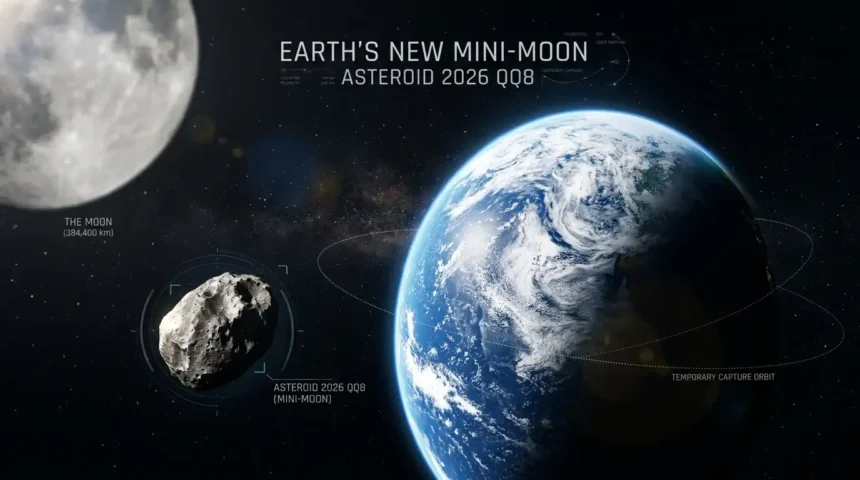
Earth has a small visitor travelling alongside it, but it is not another permanent moon. Astronomers have identified a tiny asteroid called 2026 QQ8 that has been temporarily caught by Earth’s gravity.
The space rock is only about two metres across, yet it has become an unusual companion to our planet. It entered Earth’s gravitational control in April 2026, months before astronomers spotted it. It is expected to remain temporarily bound to Earth through the end of the year before moving away in 2027.
The discovery is a reminder that Earth’s neighbourhood is more active than it may appear. Our planet does not only have one familiar natural satellite; small space rocks can sometimes spend a limited amount of time travelling under Earth’s gravitational influence.
What Is Earth’s New Mini-Moon, 2026 QQ8?
The object is officially designated 2026 QQ8. It is a small asteroid, estimated to be around two metres in diameter.
Unlike Earth’s permanent Moon, this object is only a temporary visitor. Earth’s gravity has captured it into a temporary orbit, meaning it will not remain with our planet indefinitely.
The asteroid was first observed in August 2026 by Hungarian astronomer Krisztián Sárneczky. Its temporary capture had already begun several months earlier, in late April.
The discovery was reported by the International Astronomical Union’s Minor Planet Center on October 29, 2026.
How Did Earth Capture This Tiny Asteroid?
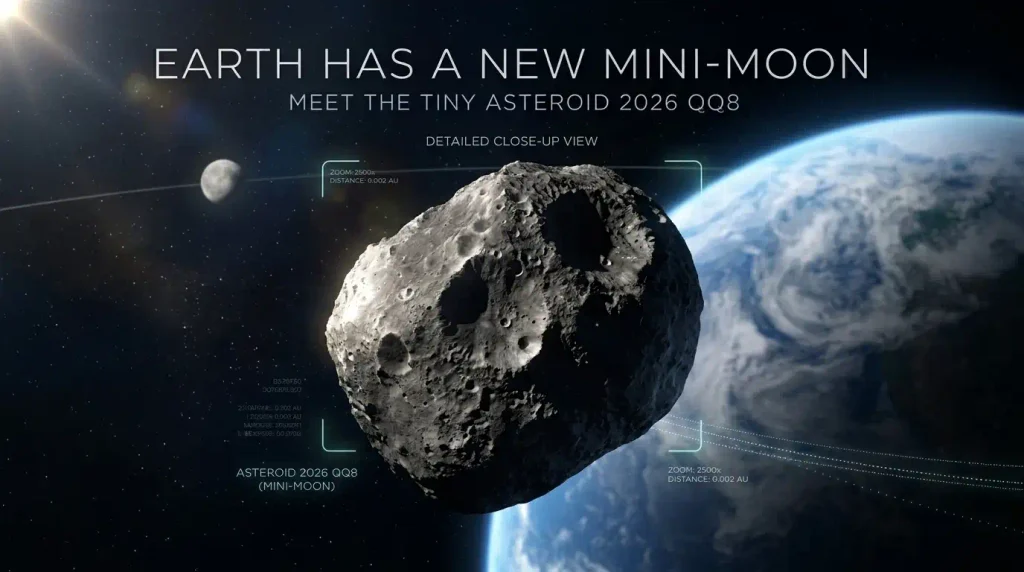
Earth’s gravity constantly affects objects moving through the solar system. Under the right conditions, a small asteroid passing close enough to our planet can become temporarily bound by that gravitational pull.
That appears to be what happened with 2026 QQ8.
The asteroid follows a path around the Sun, but its close encounter with Earth allowed our planet’s gravity to temporarily change its journey. Instead of simply passing by, the object became a short-term companion.
This does not mean Earth has gained another permanent moon. Its gravitational hold is temporary, and the asteroid is expected to break away and continue travelling through the solar system.
How Long Will 2026 QQ8 Stay Near Earth?
The mini-moon’s temporary stay began in late April 2026. Astronomers expect it to remain under Earth’s gravitational influence through December, before moving away in 2027.
Its journey is unusual because it does not follow the same stable, long-term orbit as our Moon.
According to orbital calculations reported by Space.com, 2026 QQ8 takes about 359 days to travel around the Sun. That is just slightly shorter than one Earth year.
The asteroid also comes relatively close to Earth roughly once every ten years. This time, its approach was close enough for Earth’s gravity to temporarily capture it.
How Big Is the New Mini-Moon?
Despite the exciting name, 2026 QQ8 is extremely small.
Astronomers estimate that it measures around two metres across, or approximately six feet. That is tiny compared with Earth’s Moon, which is about 3,475 kilometers in diameter.
Because of its small size and faint appearance, 2026 QQ8 is not something people can simply look up and see in the night sky.
Its importance is not its size, but what it can teach astronomers about temporary gravitational captures and the movement of small asteroids around Earth.
Is the Mini-Moon Dangerous to Earth?
There is no reason to treat 2026 QQ8 as an incoming threat.
The asteroid is expected to remain at a considerable distance from Earth during its temporary stay. Space.com reports that its closest approach during this period is about 568,000 kilometers — farther away than the average distance between Earth and the Moon.
Researchers also estimate that an object this small would likely break apart or burn up in Earth’s atmosphere if it ever entered it.
The mini-moon is therefore an interesting astronomical visitor, not a reason for public concern.
Is 2026 QQ8 the First Mini-Moon Earth Has Captured?
No. Astronomers have identified other small objects that were temporarily captured by Earth’s gravity.
These objects are often called mini-moons, although scientists also use the term temporary natural satellites.
They are usually much smaller than the Moon and do not stay with Earth for very long. Some may remain for months, while others can spend a different amount of time in temporary orbits.
Research has suggested that several small objects could be temporarily associated with Earth at certain times, although detecting them is difficult because they are faint and move across the sky.
The discovery of 2026 QQ8 adds another example to scientists’ growing understanding of these brief visitors.
Why Are Astronomers Interested in Mini-Moons?
Mini-moons offer scientists a chance to study small asteroids that come relatively close to Earth.
Their movements can help researchers improve their understanding of how gravity affects objects in the solar system. Observing their paths also helps astronomers learn more about the population of small asteroids near our planet.
These objects are difficult to detect because they are small and faint. Better observations and more advanced sky surveys could help scientists identify more of them in the future.
Even a tiny asteroid can provide useful information about how our solar system works.
What Happens When 2026 QQ8 Leaves Earth’s Orbit?
Once Earth’s gravitational influence is no longer strong enough to keep it temporarily bound, 2026 QQ8 will continue along its path around the Sun.
It will no longer be considered Earth’s temporary companion, although it will remain part of the wider population of asteroids travelling through the solar system.
Its departure will not affect Earth or the Moon. It simply marks the end of a short astronomical encounter.
Frequently Asked Questions
What is Earth’s new mini-moon called?
It is called 2026 QQ8, a small asteroid that has been temporarily captured by Earth’s gravity.
When did Earth capture 2026 QQ8?
Its temporary capture began in late April 2026, according to the reported orbital calculations.
How big is asteroid 2026 QQ8?
It is estimated to be around two metres, or roughly six feet, across.
When will the mini-moon leave Earth?
It is expected to move away from Earth’s temporary gravitational hold in 2027.
Can people see the mini-moon from Earth?
No, it is too small and faint to be seen with the naked eye.
Is 2026 QQ8 going to hit Earth?
Current reporting does not identify it as a threat to Earth. Its closest reported approach during this temporary stay is around 568,000 kilometers away.
Final Thoughts
Earth’s new mini-moon may be small, but its story is a fascinating example of how gravity shapes the movement of objects throughout our solar system.
Asteroid 2026 QQ8 was travelling around the Sun before Earth’s gravity temporarily changed its journey. It will not stay forever, and it is not a second permanent Moon. Still, its brief visit gives astronomers another opportunity to study the small objects that pass through our planet’s neighbourhood.
By the time it moves away in 2027, 2026 QQ8 will have completed a short chapter in Earth’s astronomical story — one that shows even a tiny space rock can attract plenty of scientific interest.