From space, some parts of Earth can look almost like another world. That is exactly what makes a recent astronaut photograph of southern Madagascar so interesting. A bright, unusual rock formation stands out against the darker landscape, and its appearance has drawn comparisons with the Moon.
The formation is known as the Saririaky anorthosite massif. NASA featured the image on October 5, 2026, after an astronaut aboard the International Space Station photographed it on August 28.
But the real story goes beyond its appearance. The rocks are made of anorthosite, a type of rock that is also widespread across the Moon’s bright highlands. Scientists are interested in formations like this because they can offer clues about the geological processes that shaped our planet and help researchers study the Moon’s ancient history.
Where Are the Moon-Like Rocks Found?
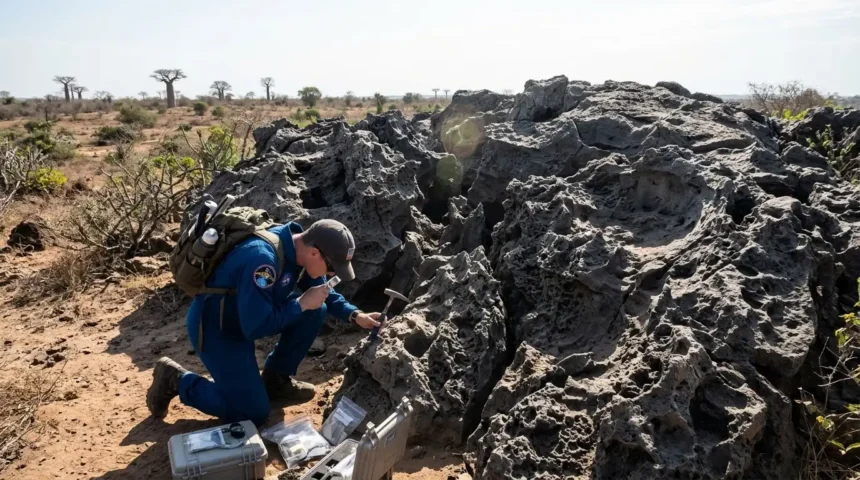
The unusual formation is located in southern Madagascar, where its pale surface creates a striking contrast with the surrounding dry, rugged terrain.
From the International Space Station, the Saririaky massif appears as a bright, rounded feature. Its exposed area covers around 100 square kilometers, making it a substantial geological formation.
The photograph was taken by a member of the ISS Expedition 75 crew. NASA later published it through its Earth Observatory project, giving the public a closer look at a landscape that is difficult to appreciate from the ground.
Although the formation looks unusual from orbit, it is not a piece of the Moon or material that arrived from space. It is an ancient part of Earth’s own geology.
Why Do These Rocks Look Like the Moon?
The connection comes down to a rock called anorthosite.
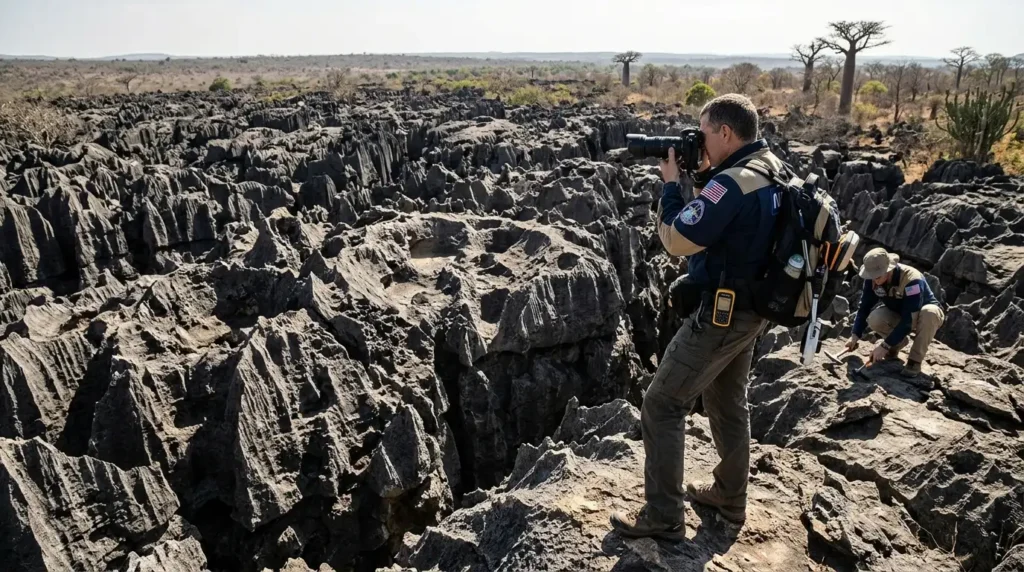
Anorthosite is an igneous rock that forms when molten material cools and crystallizes beneath the surface. It is made mostly of plagioclase feldspar, a mineral that gives the rock its characteristically light appearance.
This same type of rock is common across the Moon’s highlands. Those bright regions are among the most recognizable features of the lunar surface and can be seen from Earth.
Anorthosite is not limited to the Moon, however. It also occurs in several places on Earth, including parts of Canada, Scandinavia, southern India and Madagascar.
That is why the Saririaky massif has attracted attention. It offers a remarkable example of a rock type that is important in both Earth’s geology and the study of the Moon.
How Old Is the Saririaky Anorthosite Massif?
The formation is believed to be at least 600 million years old, placing its origins in the late Precambrian period.
To put that age into perspective, these rocks existed long before dinosaurs appeared and long before modern continents took their present shapes.
The massif’s present-day surface exposure covers approximately 100 square kilometers. Its surrounding rocks also show signs of an intense geological past.
NASA explains that the formation lies within a ductile shear zone. In simple terms, this is an area where rocks have been changed and reshaped under high pressure and temperature. The process left noticeable patterns in the surrounding rock layers.
These details make the site valuable to geologists studying how Earth’s crust changes over long periods.
What Can Earth’s Anorthosite Tell Us About the Moon?
The Moon’s anorthosite has a much older history. Lunar samples show that these rocks are more than four billion years old.
Scientists believe they formed when the early Moon was covered by a vast ocean of molten rock. As that material cooled, lighter minerals such as plagioclase feldspar crystallized and helped build the Moon’s outer crust.
Samples collected during the Apollo missions gave researchers important evidence about this process. However, lunar samples are limited, so scientists also study similar rocks on Earth.
Earth-based anorthosite cannot replace material collected directly from the Moon. Still, it gives researchers another way to examine the minerals, textures and geological processes associated with this important rock type.
The Saririaky massif adds another interesting location to that research.
Did NASA Discover a Piece of the Moon in Madagascar?
No. The rocks are not lunar fragments, and they did not fall from the Moon.
They formed naturally on Earth through geological processes involving molten rock and the movement and deformation of Earth’s crust.
The comparison with the Moon is based on their composition. Both the Madagascar formation and the Moon’s bright highlands contain anorthosite.
That difference is important because it explains why the photograph is scientifically interesting without suggesting that the formation came from space.
Why Is the Astronaut Photograph Important?
The image gives scientists and the public a useful view of a distinctive geological feature from above.
NASA identifies the photograph as ISS075-E-85249. It was taken using a Nikon Z9 digital camera with a 400-millimeter lens. The image was later cropped and enhanced to make the landscape easier to examine.
Satellite and astronaut photography can help researchers observe large geological patterns that may be difficult to see from ground level. In this case, the image makes the bright anorthosite stand out clearly against the surrounding terrain.
It also offers a reminder that some of Earth’s most interesting geological features are hiding in plain sight.
Frequently Asked Questions
Where are the Moon-like rocks in Madagascar?
They are part of the Saririaky anorthosite massif in southern Madagascar. The formation appears as a bright, rounded area within the surrounding landscape.
What makes the Madagascar rocks similar to the Moon?
Both contain anorthosite, a light-colored igneous rock that is common in the Moon’s highlands.
How old is the Saririaky massif?
Scientists estimate that the formation is at least 600 million years old.
Did NASA find actual Moon rocks in Madagascar?
No. The rocks formed on Earth. Their similarity to lunar material comes from their composition, not their origin.
Can Earth’s rocks help scientists study the Moon?
Yes. Similar rocks on Earth allow researchers to examine minerals and geological features that are also important in understanding the Moon. They do not replace actual lunar samples, but they provide useful comparisons.
Final Thoughts
The Saririaky anorthosite massif is a fascinating example of how Earth’s geology can sometimes resemble features found on other worlds. Its bright surface may look lunar from space, but its history belongs entirely to our own planet.
At least 600 million years old, the formation preserves clues about the forces that have shaped southern Madagascar. Its connection to the Moon also gives scientists another opportunity to study a rock type that played an important role in the formation of the lunar surface.
One astronaut photograph has brought attention to this unusual landscape — and shown just how much there is still to learn about the planet beneath us.